
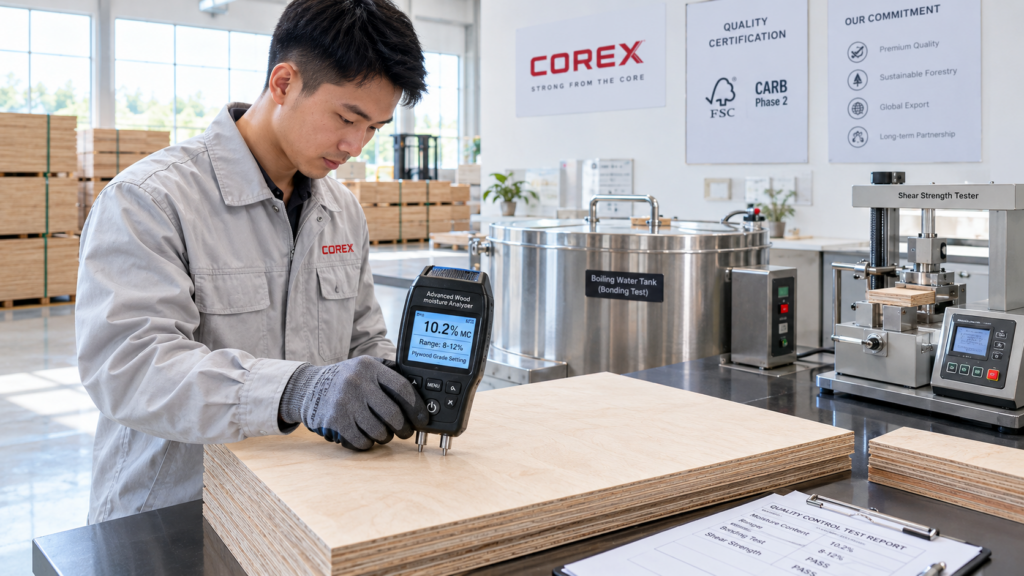
Importing commercial plywood in bulk carries significant risks if moisture levels or bonding strength fail to meet destination standards. A single container with delaminated sheets or mold can cause thousands of dollars in claims. Here is the exact step-by-step quality control (QC) protocol professional buyers use before loading cargo in Vietnam.
To safeguard your import margins, quality assurance must occur directly at the factory floor before containers are sealed. This guide outlines the exact, step-by-step laboratory and field testing protocols international B2B buyers use to evaluate plywood bonding durability, moisture content, and dimensional tolerances in Vietnam.
1. Checking Moisture Content (MC): The 8–12% Export Standard
Wood is a hygroscopic material that continuously absorbs and releases moisture relative to its surrounding environment. Excess internal moisture leads to swelling, core telegraphing, and mold growth during long ocean transit voyages (30–45 days in sealed containers).
For interior and furniture-grade commercial plywood, target moisture content must strictly remain between 8% and 12% upon final inspection.
Inspectors must use a calibrated pin-type or pinless digital moisture meter, taking reading points at 5 distinct locations on each sample sheet (the 4 corners and exact center).
For disputed batches, moisture content is verified according to the official ISO 16979 / EN 322 standard via oven-drying at (103 ± 2)°C until constant mass is achieved.
Different timber species absorb moisture at varying rates. Hardwoods like Eucalyptus behave differently under kiln-drying compared to Acacia or Styrax core veneers. Learn how core species impact stability in our Commercial Plywood Core Species & Face Veneer Grading Guide.
2. Evaluating Bonding Quality: Boiling & Shear Testing Matrix
Bonding strength reflects how well adjacent veneer layers remain fused under thermal and hydraulic stress. Glue line durability is evaluated by subjecting sample cut-outs to water immersion and boiling pretreatments as defined in ISO 12466-1 / EN 314-2 and ASTM D906 standards.
| Glue Grade | Boiling / Immersion Test Method | Bonding Class Target | Recommended Application |
|---|---|---|---|
| MR Glue (Moisture Resistant) | Submerge or boil samples in 100°C water for 30 to 60 minutes to ensure zero edge delamination. | EN 314-2 Class 1 (Dry Interior) | Indoor furniture, door cores, packing crates, and dry paneling. |
| Melamine WBP (Water Boiled Proof) | Boil samples in 100°C water for 4 to 24 hours continuously depending on specified bond rating. | EN 314-2 Class 2 (Humid / Protected Exterior) | Kitchen cabinets, bathroom furniture, and humid environment partitions. |
| 100% Phenolic WBP | Boil samples for 24 to 72 hours continuously without edge separation or glue line failure. | EN 314-2 Class 3 (Unprotected Exterior) | Concrete formwork, marine plywood, exterior cladding, and heavy flooring. |
Boiling water resistance tests physical bond durability, but does not guarantee indoor air safety. Ensure your chosen WBP or MR resin also complies with destination emission laws such as CARB P2 or E1. For a complete breakdown of formaldehyde regulations, read our CARB P2 vs E1 vs E2 Formaldehyde Guide.
3. Visual Inspection, Thickness Tolerances & Inspection Checklist
-
Thickness Consistency (±0.3 mm Tolerance) Measure panel thickness using a digital caliper across 8 distinct positions per sheet. Variance must not exceed ±0.3 mm for premium panels to avoid fitment issues during automated CNC machining.
-
Chisel & Knife Shear Test (>80% Wood Failure Target) Insert a chisel into the glue line and pry plies apart. Examine the wood fracture percentage: a passing bond must show cohesive wood fiber rupture targeting >80% wood failure rate rather than peeling clean along the glue seam.
-
Surface Defects & Core Joint Audit Inspect face veneers for core voids, overlapping plies, dead knots, unglued pockets, or heavy sanding marks before pallets are strapped and plastic wrapped.
-
Mandatory Random Sampling (AQL 2.5 Standard) Never rely on factory-provided pre-cut samples. Require your QC inspector or 3rd-party agency (SGS/Intertek) to pull sample sheets randomly from finished crates.
Need Verified Quality Before Bulk Orders?
At CoreX Plywood Vietnam, every export shipment undergoes rigorous 5-point moisture readings, 8-position thickness checks, and boiling shear tests before container loading:
- Request Express Sample Kit: Receive a custom sample kit delivered directly to your office via DHL/FedEx, complete with our official pre-shipment QC test report.
- Guaranteed Moisture Threshold: Strict 8–12% moisture control preventing transit mold.
- Complete Procurement Guidance: Follow our step-by-step roadmap in How to Source & Order Plywood from Vietnam to secure your next order.